
WHY DO WE NEED TO TALK ABOUT PERSONAL FREEDOM?
We did not set out to build a think tank. We set out to answer a question that seemed strangely under-examined: are individuals actually freer than they once were, or does it merely feel that way?
By most conventional measures — democratic participation, civil rights, the rule of law — a number of established indices already track how "free" societies are. But something was missing from that picture. Those indices measure how a country is governed. They do not measure how free a person actually is in the conduct of daily life — what one may do, say, choose, and keep private, without requiring another's permission.
That gap is what the Personal Freedom Institute exists to address. And the closer we examined it, the more urgent the matter appeared — because personal freedom is not only under pressure in the familiar, visible ways. It is being eroded quietly, through technology, often with our own consent.
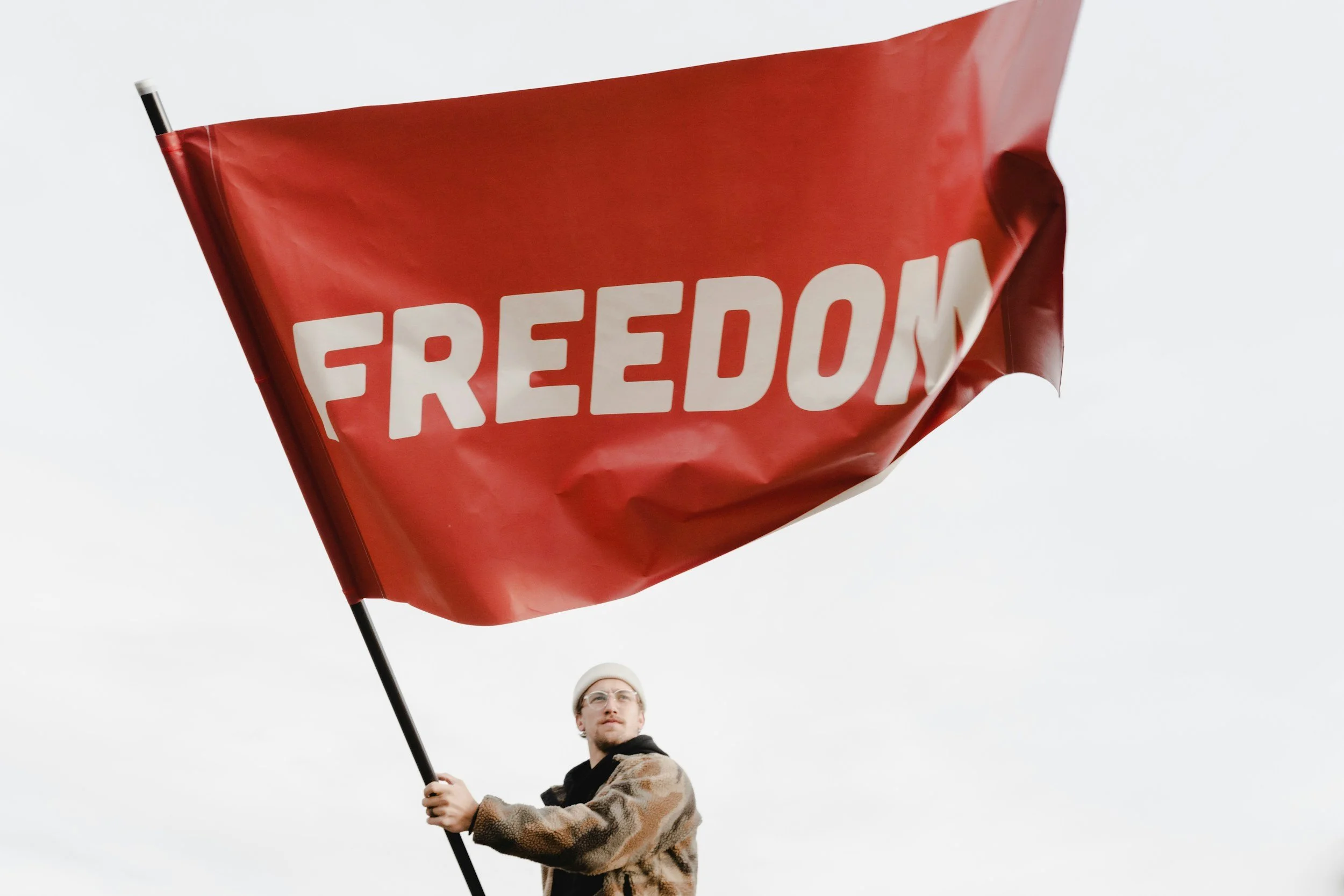
Freedom is often viewed as a political concept, yet its most important expressions are deeply personal. This image reflects the central question explored in this essay: how much freedom do we truly possess in our daily lives, and what are we quietly giving away in exchange for convenience?
The trade we did not quite agree to.
We want to be clear at the outset: this is not an argument that technology is a negative force. Quite the opposite is true. The past two decades of technological change have delivered substantial, tangible improvements to how we live — convenience that would have seemed implausible a generation ago, productivity gains that create genuine time and capacity, entertainment and connection available on demand, tools that place considerable capability in the hands of ordinary people. None of this is in dispute, and none of it is what the Institute is challenging.
But convenience carries a cost, and that cost is rarely itemised.

Each frictionless login, each application that anticipates a preference, each device that listens in order to assist, depends on a quiet transaction: a small measure of privacy, of anonymity, of unmonitored space, is exchanged for ease. Any single transaction of this kind is trivial, and few would decline it in isolation. But such transactions compound over time. Anonymity, once a default condition of everyday life, has become something that must now be deliberately constructed — through effort, through tools, occasionally through cost. Most people do not construct it, largely because most are unaware the exchange is taking place at all.
This is the aspect that concerns us most: not that freedoms are being eroded, but that they are being eroded without deliberation. The public was not consulted. No one was directly asked whether they wished to live under facial recognition in public spaces, under persistent location tracking, or subject to algorithmic decisions they can neither observe nor contest. These conditions arrived incrementally, one convenient update at a time.
Why measurement matters
A society cannot deliberate meaningfully about a trend it cannot see. The Institute's first undertaking, accordingly, is the Personal Freedom Index — a systematic effort to measure personal freedom across all countries, assessed not through the lens of governance or democratic process, but through the lens of daily life: what individuals may actually do, move, express, own, and keep private.
Notably, this includes a category that comparable indices address only partially, if at all: digital and technological freedom. Surveillance regimes. Encryption policy. The legal status of tools such as VPNs. The proliferation of facial recognition. The right to own a device anonymously. These are no longer peripheral concerns; they are becoming the principal terrain on which personal freedom is either preserved or quietly relinquished.
What we hope to start

We do not believe the appropriate response is to reject the conveniences technology provides — nor do we expect that most people would wish to. We do believe, however, that such trade-offs deserve to be made knowingly rather than by default. That requires two things currently in short supply: reliable data, and open discourse.
That is the purpose of this Institute. We will publish research, measurement, and commentary — not to prescribe what people should think about freedom, but to offer a clearer account of where it presently stands, and how rapidly that position is shifting.
If personal freedom is a matter of concern to you — whichever dimension of it you find most pressing — we would welcome your attention, and your disagreement where it arises. That disagreement is, after all, rather the point.